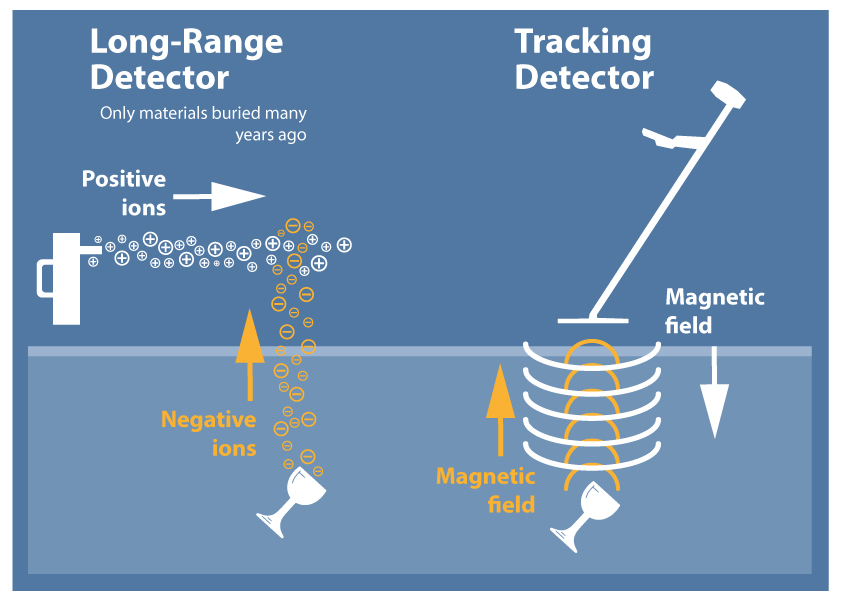
The image shows two distinct detection methods, each based on different physical principles and suited for specific types of targets and search scenarios.
The Long-Distance Detector operates through ionic detection, capturing positive and negative ions released by metals and substances that have been buried for long periods.
Over the years, these materials undergo natural oxidation and interaction with the soil, releasing ions that rise to the surface and spread in the environment. The detector captures this ionic field and indicates the direction of the target, even at a distance.
Main features:
In the image, ions are represented rising from the soil and being captured at a distance.
The Tracker Detector works through a electromagnetic field generated by the coil. When this field encounters metal, an immediate response occurs, which is detected by the device.
Unlike ionic technology, this method does not depend on the burial time of the object, allowing detection of both old materials and recently buried objects.
Main features:
In the image, the magnetic field is shown as circular waves beneath the coil.
| Long-Distance (Ionic) | Tracker (VLF) |
|---|---|
| Directional detection | Scan-based detection |
| Operates at a distance | Operates near the user |
| Captures ions in the environment | Captures electromagnetic response |
| Detects only materials buried many years ago | Detects both old and newly buried materials |
| Ideal for large areas | Ideal for localized searches |
The image highlights that the technologies have complementary functions.
The long-distance ionic detector is recommended for locating deep and old targets in extensive areas, while the VLF tracker is essential for detecting any metal, including recently buried objects, and confirming the exact target location.
This combination provides greater efficiency, precision, and time savings in professional prospecting operations.
